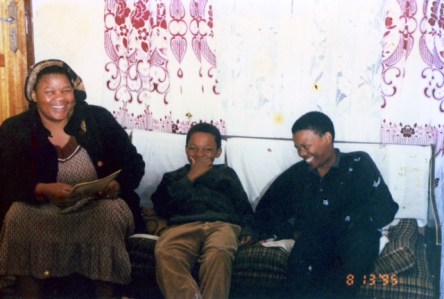
Thirty-seven years ago today, just when the dust had settled following the countrywide celebrations to mark the 15th anniversary of Botswana’s independence, I was born to a miner and a seamstress, at the Kanye Seventh-Day Adventist Hospital.
I want to celebrate this special day by telling you bits about the seamstress.
In 1954, around the time De Beers started prospecting for diamonds in the Bechuanaland Protectorate, my mother, Gaontebale Florence, was born on 6 February at Goora Mokhai ward to Rre Sebatlo le Mme Ontefetse Babusi. Ontefetse delivered Gaontebale in her rondavel, the planned home-birth was carried out by a traditional midwife. Abject poverty was rampant in the country around the time, particularly due to the costly hut tax system. The British colonialists had extended the tax to every “native” occupant of a hut. Partly to this, most men migrated to neighbouring Apartheid South Africa to work as labourers in the Gold Mines.
Gaontebale learned to read and write at King George V School in Kanye. She would later attend the Ramatea Brigade where she graduated with a certificate in Home Craft.
At 20, she married the 33-year-old Rre Lekgoanyana Kgasa. And the following year they were blessed with a baby girl. It is from this child that she would be known: Mmaagwe Molly.
Shortly after relocating to her husband’s kgotla, my mother tells me that as much as it was tough for her as my father was away in SA digging gold, she had loads of ideas on how she could supplement the household income. She says she was struck by the unused space in her new home. She then started planting peaches, grapes, lemons, pomegranates and granadillas. Although most people warned her that she was simply wasting her time owing to the infrequent rains, she cultivated her orchard. It was from this orchard that my love for fruits was cultivated.
Further, just outside her new home, was a spacious bush area. According to my mother, the area was used as a thotobolo ya matlakala, or dumping site. And she realised that the site was big enough to hold another building. She had other ideas. It was then that she started visualising a shop there that she could easily run. Although she had written to my father and sensetized him, it was not until about 6 months later when he visited home that she shared her vision face to face. While sceptical, he fully supported the ambitious project regarding the thotobolo site. My mother tells me that it was not easy navigating her way around the application for the site at the Kanye Land Board offices in the 1980s, and also that she was usually the only woman at these meetings. However, she had realised that overstating my father’s salary seemed to make the men interrogating her satisfied and reaffirmed, perhaps to the illusion that there was indeed a man behind the idea. After going back and forth she was finally allocated free land to build and run a business right in her own backyard.
My mother always reminds me of the challenges she faced with my father prior to opening the shop. First, there was a Kgwanyape hailstorm around the late 1980s, that dismantled the whole roofing and part of the wall. To make matters worse the building was not insured. Second, following the storm, my father lost his job in 1989. Making the 35-year-old mother of three the sole breadwinner. Borakanelo General Dealer finally opened in 1994. Her choice of name, Borakanelo, means the meeting point. I fondly remember the countless bus journeys to Gaborone I took with my mother to buy colourful dresses, viscose shirts and wall clocks for Borakanelo.
In 1995, at 41, Gaontebale learned to drive. In her words, one of the most liberating things she has ever done for herself. It was not until the year 2000 when she finally owned a car, the year that BTV, Botswana Television, was also born.
In 1997, my mother opened her seamstress business, this one was right in her home. She employed 4 talented women and they designed curtains, pyjamas, as well as dresses. They also altered trousers, blouses and more. Fittingly, the “go roka” business was conducted in the harabese, the thatched house that was my parents’ first house.
The winter of 2009 is a time I will remember in all its intensity for the rest of my life. The experience of handing my mother tons tissues and seeing her drinking countless bottles of water is deeply affecting and life changing. It was at the time when my sister had gone back to Masunga and my brother was at UB. While her mother was there with us, for me it was a deeply affecting period as I had never seen my mother in such state. I must add that it was that I also became very aware of the significance of my mother’s community: family, church, work colleagues and the community.
I enjoyed watching the Dinaletsana, the Under-21 Netball team, on BTV during the 2017 Netball World Youth Cup with my mother and her mother. As the game intensified my mother urged the girls forwad when they were trailing against Jamaica. She often criticised the forwards for missing open goals. GS, GA, GK, she knew the positions well. “Ha nne e le nna e ka bo ke e nositse” (if it were me I would have scored). My mother was a netball player during her time at King George. She often reminisce of her ball days with great joy.
If there is one thing most people don’t know about my mother is that she is a brilliant storyteller. She can also imitate anyone. She is so good at it I think given an opportunity, she could have been a successfull theatre actor if not a movie star.
Sometimes I wish I could actually see my mother when she was 5, 11, 18, or 25, but I believe that little girl is well alive in her. I am reminded of one cold afternoon in 2017: as soon as she finished her ritual prayer, she carefully reversed the car from her jarata to drive with me around the village. Suddenly, she stopped the car and in a high-pitched voice, greeted two elderly men. She then instructed me to get out of the car. I exchanged handshakes with the gentlemen before my mother took a picture of me flanked by the legends. As we drove away, she told me that she wishes that I had seen them during their younger days. And not only see them but hear them speak eloquently too. One elderly man was her teacher at King George, Rre T.T. Mosimakoko, and the other was Rre M.U. Leinaeng, then a popular Radio Botswana broadcaster. She continued going on and on about the gentlemen when they were younger, mimicking them!
One of my favourite photos include the one from the warm afternoon of 29 March 2018, wrapped up in uniform of the iconic “Basadibotlhe” tjale, is my mother together with a group of married women, from the groom’s family, as they snaked their way into the bride’s family home to finalise negotiations in seeking the bride’s hand in marriage. Waiting, in the home yard, was a large number of married women from the bride’s family, similarly adorned in the blue di-tjale. Traditionally, it is the Patlo ceremony that a marriage is formalized. “Patlo ke yone ke yone”, alluded my mother, on the evening of 28 March 2018. When she was patiently advising me on how to go about taking pictures at the Kanye Main Kgotla and the Bride’s family home to avoid being too intrusive to the ceremony.
I enjoyed watching my mother singing, dancing, and ululating together with other women. Together with my father, they have always gone to a Patlo when I was growing up. To have the opportunity to witness her at one was an honour.
Please join me today as I thank and honour my first country, the first place I ever lived (Nayyirah Waheed), the one that carried me in her body. For giving me life, the basis and opportunities I had/have and most importantly for being a reference and an inspiration to me to do what I actually want in this life. In the words of James Baldwin, my mother bought and paid for my crown, all I have to do is wear it.

 Blessing Kgosi e tsile Kgasa