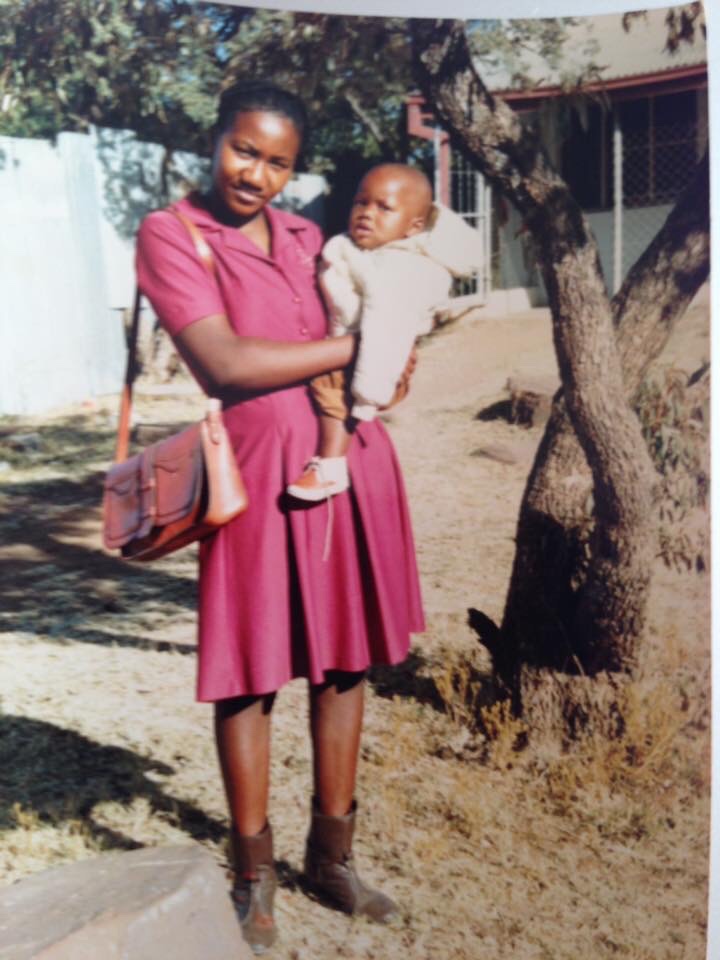
Thirty-eight years ago today, I was born to a miner and a seamstress. While there was a period my maternal grandmother took care of me while also herding goats, I was raised by women employed by my mother. In this picture taken around 1982, is Kgakgamatso holding baby Nkgosi. I want to celebrate this special day by telling you bits about women such as Kgakgamatso who took great care of me.
As I got older, I became accustomed to a woman walking into our home when the 7am RB1 news were on. She would make porridge, she would then sweep the yard, later she would hand-wash our clothes and while they dried, she would cook lunch, usually, ko matlhakwaneng.
Sometimes, in preparation for lunch, she would walk to the nearby Mabogo Dinku fresh produce to buy vegetables and then to Monate butchery if not Sunrise butchery, to buy some beef. During school holidays, I always looked foward to the times she would send me to the buchery, reasoning that she had a “washene” to do. I always agreed and was often rewarded with a piece as big as my father’s. And around 5pm, she would walk back to her home.
I vividly remember women such as Nonofo; Ruta; Mma Sekhakha; Mma Tonoko; Mma Seperechane; Mma Soriletsile; Mma Lentle, among others.
Quite often, I enjoyed her captivating stories and songs. I particularly liked going through the Supreme Furniture catalogue with her. As a young boy, I giggled with great joy when some passerby men attempted to strike a conversation with her.
It was often when she asked for a day off to take a child to the hospital that, perhaps, I started realising that, she too, like my mother, has her own children.
It’s important to also note that I witnessed most of the times she was getting paid, cash in hand. I recall we would know that it’s month end when she would consistently ask my brother and I whether our mother was already back from work.
While I have directly benefited from the extreme inequalities in Botswana, and perhaps, even programmed to feel entitled and perhaps lazy, I think these women domestic workers have provided me with a great foundation to not only partially understand extreme inequality in our communities but also how we could tackle it for a more equal world.
Despite not being aware of it at the time, I now believe that part of my inspiration to study the socio-economic environment of Gasita village is inextricably linked to my memories of these women.
I was happy to see Ruta and Mma Tonoko recently. While they did not recognise me at first, they were thrilled to realise that I was the boy they raised.
Please, join me today as I thank these often unappreciated, unrecognised and taken for granted mothers of the nation.
Ke a leboga bo-Mmamane!


