In the village of Kanye, one of the popular South African migrant labour-sending areas, among the elderly, it is well acknowledged that back in the days, as soon as an “uneducated and unskilled” young man was about 20 years, he would visit the Native Recruiting Corporation offices situated in the village, well known simply as NRC, “go tsaa joini”, or to get joini.
The NRC was a well known migrant mine work recruitment organisation and in 1977, together with the Witwatersrand Labour Organisation were amalgamated to form The Employment Bureau of Africa (TEBA) (Mpedi and Nyenti 2013). To this day the name NRC is very popular in the village and is often associated with migrant mineworkers recruitment.
Because miners were often employed as contract labourers, the recruitment procedure was popularly refered to as “joini”. Under joini (derived from to join), with no certainty of re-employment, miners were contracted to temporary employment of about 12 months in any of the South African mines, in areas such as Carltonville, Roodepoort, Rustenburg and Sterlfontein among others. It did not matter that miners were employed for 20 years in one mine, every time they returned to their country of origin, effectively they were unemployed, because, upon return, they would still have to go to the NRC “go tsaa joini”.
While appreciating that former migrant mineworkers and their communities as well as labour-sending governments have benefited meaningfully from the South African mines, perhaps, how this casualisation of employment could be conceptualised and understood is through the post colonial theory lens. Therefore, it’s critically important to bring out the linkage between this labour migrant procedure and apartheid system. Apartheid (Afrikaans for “apartness”) was a system of government implemented in South Africa between 1948 and 1994 that enforced racial segregation and socio-economic discrimination (Cook 2013), extending to “every aspect of society, with separate sections in public transport, public seats, beaches, and many other facilities” (Ashcroft et al. 2000 p. 14).
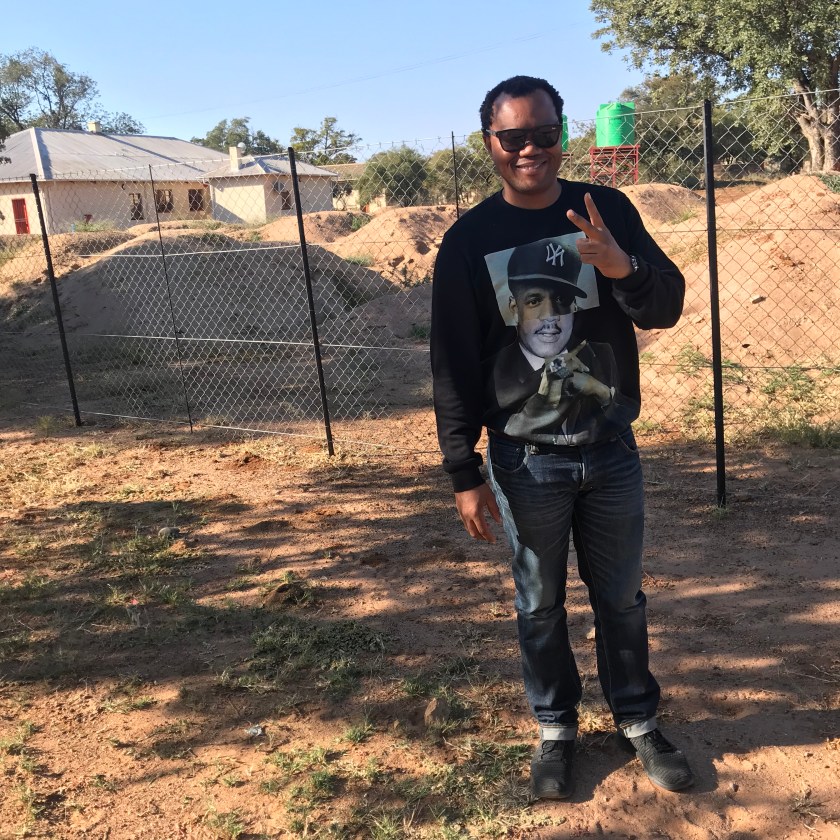
On the 30th of May 2019, a day before I flew out to London, I drove with Mmaagwe Molly, my mother, to the NRC, “go tsaa joini”, at least symbolically . Clearly the offices, under renovation as you can see in the picture, are now used for something else. She went on to fondly recall that “bo-Rraagwe Molly nne ba tlhola ba tletse fa!” Despite struggling with the harsh winter sun in her eyes, she took this historic photo of me: stepping on the very same soil my father Rraagwe Molly, his father, cousins, uncles and other countless former migrant mineworkers queued on “go tsaa joini”.
As a descendant of a migrant mineworker, himself a descendent of a migrant mineworker, I’m extremely honoured and thankful for the responsibility I have to one day, in my natal village, as a loving tribute to preserve the memory of those who came before us, those who inspire us:
sit down with former migrant mineworkers, their widows, and dependants: to interview, record and document their experiences, together.
Yena Chaile Madoda!


