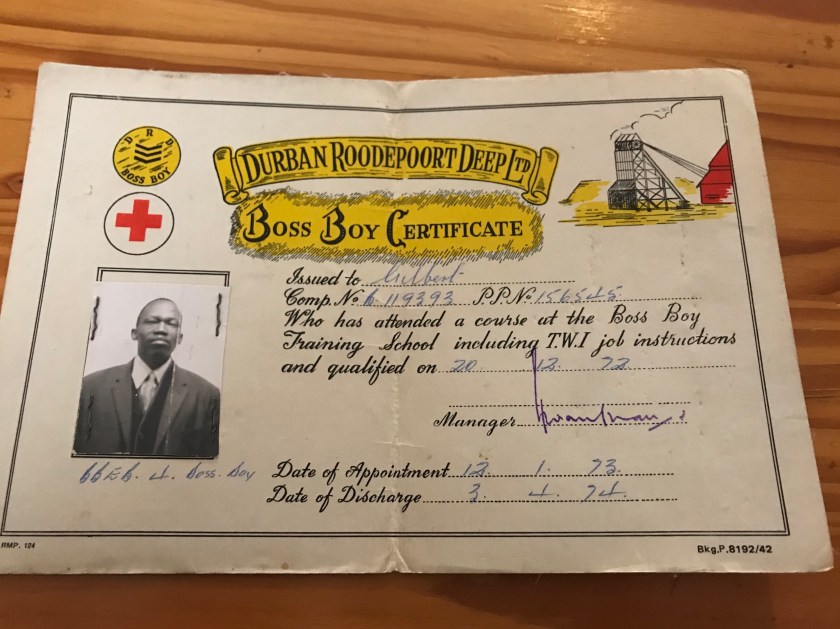
My late father, Rre Lekgoanyana Kgasa, worked at the Durban Deep Mine at Roodepoort in racially segregated South Africa, for more than 20 years. On his bedroom wall, in bold letters, his framed Mine Certificate read: Stope Team Leader, with letters TEBA at the bottom. TEBA is an acronym for The Employment Bureau of Africa, which was established to recruit migrant labour for the South African gold mines from neighbouring countries such as Lesotho, Namibia, Swaziland, Zimbabwe, Malawi, Mozambique and Botswana. Remember Hugh Masekela’s ”Stimela” song?
I remember one rainy morning when I was about 11 years old as I marched to school rocking his bright yellow safety-helmet, which, in black letters read: Team Leader. Although nobody saw me at home, another ex-miner, his sister’s husband saw me and alerted his brother in law. I never touched the helmet again.
He lost his job in 1989 when he was just 47 years old. From what my mother tells me the money he was given upon his sudden loss of work was not even what he earned in a year.
The only change I immediately picked up at home was that my used to be absent-father was now always home when I arrived home from Mafhikana Primary School, where the 8 year old me was in Standard 2. My 14-year-old sister was in Form 2 and my 6-year-old brother still at creche. Our 34-year-old mother was now the sole breadwinner.
I remember the pride in his eyes to this day when his store, Borakanelo, opened in 1994. That meant after seeing Papa cutting hedges at home for at least 5 years, he was now the manager of his store. I still remember him, vividly, chewing toffees, strolling around the store, praying every morning before he opened the store and the countless conversations he appeared to be enjoying with the customers, most of whom he knew: if not their parents, grandparents or great-grandparents. I’m often reminded of the countless people whom he always let us write their names on the store book so they could pay later for the milk, sugar and bread.
Sometimes I wonder, whether he found great joy in noticing the missing 2 Pula coins from the inside of his Roodeport bought jackets in the wardrobe. Knowing very well that it was his naughty boys who had helped themselves to the coins from the general dealer.
Of course, my mother is one person who critically supported my father after his unfair redundancy. Although unknowingly his children too, mentally that is. His siblings as well as neighbours and relatives.
The church, Mafhikana Seventh Day Adventist was equally important. My father was a deacon for a very long time. A position that, from my observation, not only was he helping at church but the church also helped him. I am often reminded of the anger in his eyes when he realized that I had instead rushed home to avoid Selalelo or the Lord’s Supper when I was about 16 or 17 years old. He took the 5 minutes journey from church and forced me to go get my feet washed to partake in the special day. I remember the joy he would have when around other males as we washed our feet and shared jokes. I remember that from that day forward I never missed the Selalelo again.
What is also interesting is that at home, in everyday conversations, my father would casually drop a line or two of the Fanakalo pidgin language. As much as Setswana defined him, Fanakalo defined him. Fanakalo is a makeshift South African pidgin language mainly used in places of work, particularly in the mines. According to Cole (1953), its vocabulary is roughly 70 per cent Nguni (mainly Zulu), 24 % English and 6 % Afrikaans.
According to my mother, my father was deeply affected by the manner in which he lost his job. Perhaps what added salt to the injury was that he was also underpaid for his services. I remember back in 2009, still in deep shock, when I interrogated my mother on how my father was few weeks before he passed. She stated that he was constantly talking about what was due to him from the Durban Deep Mine.
Of course, this is not an isolated story. A large number of Batswana men have experienced this ordeal or something similar. I can talk all day about my uncle Two Colour; I can talk all day about my uncle Obanka; I can talk all day about my aunty’s husband and I can talk all day about our neighbours.


